
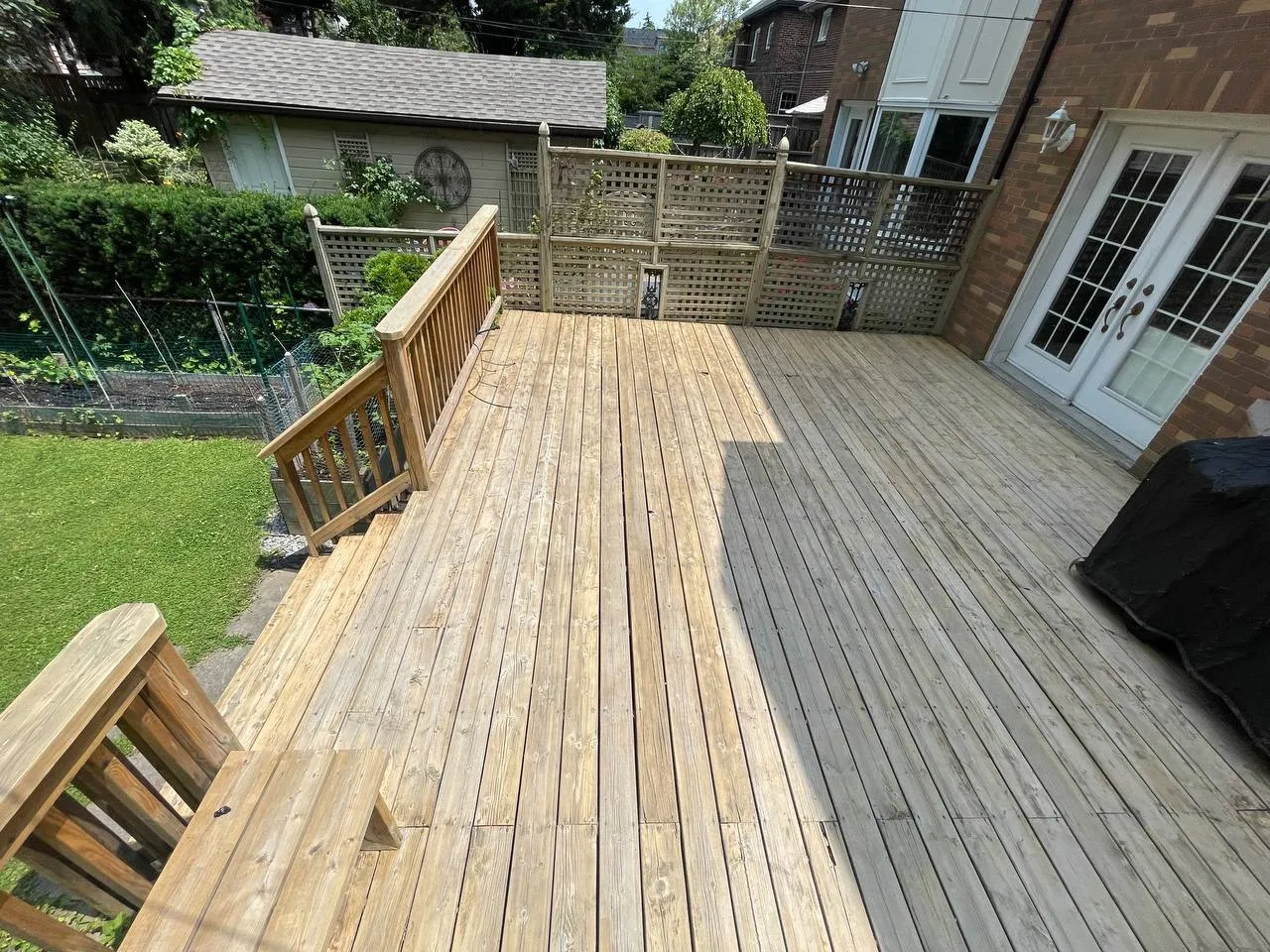
Need Deck Staining in North York?
North York was built for backyards. The postwar subdivisions of the 1950s and 60s dropped bungalows and split-levels onto wide lots, and most of those lots ended up with a deck off the kitchen or a walk-out. Sixty years on, the trees planted with those houses are full grown, so a lot of these decks sit in shade half the day and stay damp after the yard has dried.
That deck takes more weather than any other wood you own. It faces straight up at the sun, so it collects UV a wall never sees. Snow sits on it from December through March, meltwater soaks into the grain, freezes overnight, and pushes the fibres apart the next afternoon. Then road salt rides in on everybody's boots.
The grey is not dirt, and that is the useful part. Sunlight breaks down lignin, the natural glue holding wood fibres together, and it only reaches the top fraction of a millimetre, because light travels no deeper into wood than that. What is left is a thin layer of loose, dead fibre on sound wood. Stain rolled over it bonds to that dead fibre, and dead fibre lets go. That is the deck that looks great in June and flakes by spring.
We stain decks across North York, from the ravine-backed yards in Parkwoods where boards stay wet and grow mildew, to the wide tree-covered lots in Don Mills. Same wood, same weather, and the prep is what decides whether a finish holds.
What Deck Staining Actually Takes
The colour takes an afternoon. Everything in front of it is the actual job.
We start by reading the deck. A few drops of water tell us most of what we need. If they bead and sit there, the old finish is still sealing the wood and nothing new goes in until it comes off. If they soak in inside thirty seconds, the wood is open. Benjamin Moore calls for the same water test in its deck stain data sheet, and caps the wood at 15 percent moisture content.
Then we clean. An oxygenated wood cleaner lifts mildew, green algae, and that grey dead fibre without chewing into the sound wood underneath. Where an old solid stain has started peeling, cleaner is not enough and it gets stripped instead.
The wash is where most decks get wrecked. A pressure washer set for a driveway will shred a cedar board in one pass. We stay in the 500 to 1,200 PSI range with a 25 or 40 degree fan tip, hold the wand a foot or more off the boards, and move with the grain.
Next comes the brightener, the step weekend jobs skip. An alkaline cleaner leaves the wood at a raised pH, and stain on high-pH wood dries blotchy. Oxalic acid puts the pH back, pulls the black iron staining out from around fasteners, and knocks back tannin darkening in cedar.
Then we wait. Wet wood cannot absorb a finish, and anything sealed over damp fibre blisters. Two dry days is the minimum after a wash, longer in shade.
Anything soft, split, or badly cupped gets handled before the finish goes on. Popped screws go back down, splinters get sanded, and soft boards get swapped. Structural work is a different trade. The City of Toronto requires a building permit for a deck more than 60 centimetres above grade, which covers most walk-out decks on these lots, and the city's building permit requirements spell it out.
The last call is the product, and horizontal wood is its own problem. A film-forming solid stain on a flat board traps water against itself and peels in sheets. The same product on a railing sheds water and lasts for years. So penetrating finishes go on the deck field, and solid coatings go on the vertical wood.
Deck work usually gets booked with the rest of the outside of the house. Co Painting in North York runs one crew across the property, so it lands on one schedule.
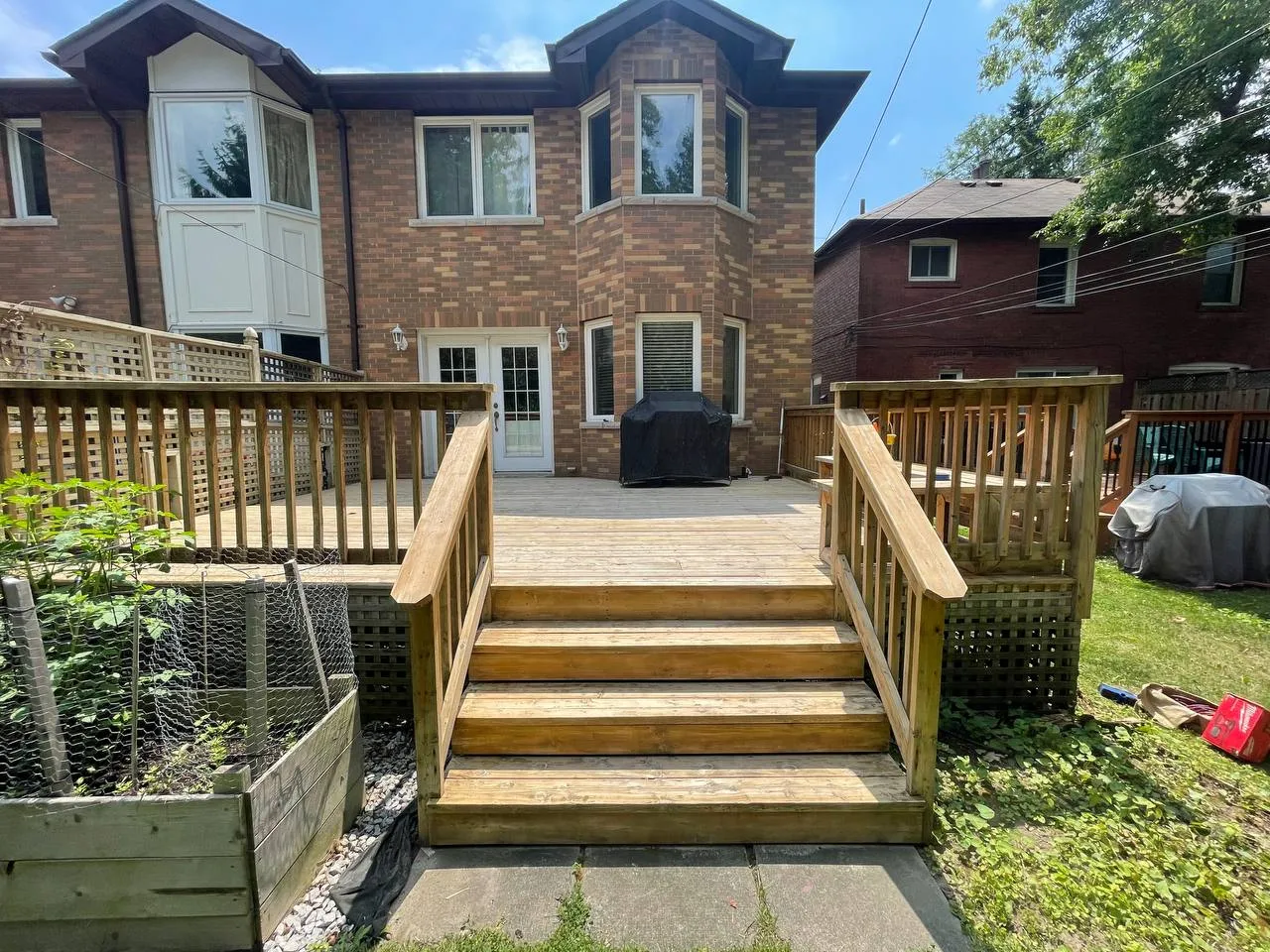
Deck Staining Services in North York
Full deck restaining
Wash, brighten, dry, sand, and stain the deck field, the stairs, and the landings as one job. We run two or three boards at a time, full length, and never stop mid-board. Stop mid-board and you get a lap mark you will read from the kitchen window for years.
Railings, spindles, and stairs
There is far more surface in a railing than people expect. Every spindle has four faces, each catching sun and rain from a different angle, so this part is brush work.
Low-pressure washing and mildew treatment
Shaded North York decks grow mildew and green algae, worst on the north side of the house and under mature trees. We treat the growth with an oxygenated cleaner rather than blasting it off. Mildew left in the wood grows back up through fresh stain.
Stripping a failed finish
Solid stain and deck paint do not fade away politely. They peel. Once a film starts lifting, the only honest fix is taking it all off, so we strip, neutralise, and bring the wood back to a surface that holds.
Soft board and fastener repair
We swap boards that have gone soft, reset popped screws, and clear the black staining iron fasteners leave in wet wood. A rotting post base or a ledger pulling off the house is a carpenter's call. We flag it and stain what is sound.
Solid colour deck stain and deck paint
Solid stain hides a lot. On an older deck with mismatched replacement boards it evens the surface out, and the extra pigment blocks more UV than a light tint. The trade-off is upkeep, since it wears through at the traffic lanes and stair noses. On cedar it needs the right primer, or tannin bleeds through. Ask for deck painting and this is the service you get, with the same wash, dry, and sand sequence in front of it.
Semi-transparent and penetrating finishes
These soak in instead of forming a skin, so the grain still reads and the finish wears away rather than flaking. That pays off next time, when a clean and a recoat replaces a full strip.
Pergolas, gazebos, and privacy screens
Overhead wood and screens weather at a different rate than the deck under them, so left alone you end up with two colours in one yard. We finish them on the same visit, and built-in benches and planters get the same sequence.
Why choose us
Why North York Homeowners Choose Us
We test the wood before we open a can
A few drops of water and a moisture reading tell us whether the deck is ready. Under 15 percent moisture, with water soaking in inside thirty seconds, is the green light. If it fails, we come back another day.
Deck pressure, not driveway pressure
500 to 1,200 PSI, a 25 or 40 degree fan tip, the wand held a foot or more back, always moving with the grain. Softwood tears under a narrow tip, and once the fibres are open the board stays furry. A wrecked cedar board does not sand back to new.
The right finish for the surface it sits on
Flat boards hold water, so a film sitting on top of them eventually peels. Vertical wood sheds it, so a film survives up there. We pick the product for where it is going, not one can for the whole backyard.
Fifteen years on the tools, backed for three
Our crews average fifteen years of painting and staining, we are rated 5.0 across 70 Google reviews, and we are insured and licensed in Ontario. The work carries a three-year warranty. If a finish we applied fails in that window, we come back.
Nine Things Worth Knowing Before You Stain a Deck
- Wash before you stain. A new coat bonds to whatever is on the surface, and mildew and grey dead fibre are not worth bonding to.
- Brighten after you clean. An alkaline cleaner leaves the wood at a raised pH and stain goes on blotchy. Oxalic acid brings it back and clears the black rings around fasteners.
- Do the water test before you buy stain. Drops that bead up mean the wood is still sealed. Drops that soak in within thirty seconds mean it is ready.
- Get the wood under 15 percent moisture. That is the number stain manufacturers spec, and it is why a washed deck gets two dry days first.
- New pressure-treated lumber is not ready on day one. It arrives wet, and smooth boards carry mill glaze off the planer that has to be sanded before stain soaks in.
- Watch the thermometer and the calendar. Deck stain wants air and surface temperature above roughly 4 degrees Celsius, which puts the real Toronto window from late April to mid-October.
- Never stain in direct midday sun. Hot boards flash the stain off before it penetrates, and the wet edge dries ahead of you.
- Two thin coats beat one heavy one. A thick coat on a flat surface stays tacky, grabs dirt, and never fully cures.
- Give it 48 hours before the furniture goes back. Chair feet and BBQ wheels on a soft finish leave prints you cannot sand out.
FAQ
Deck Staining Questions, Answered
How often should a North York deck be restained?
Two to four years for most decks. Sun and foot traffic matter more than age, and a south-facing deck with no tree cover burns through a finish faster than a shaded one. The tell is water. Once drops stop beading and start soaking in, the finish is done.
Should I use stain or paint on my deck?
On the flat boards you walk on, a penetrating semi-transparent finish usually wins, because it wears down instead of peeling off. Solid stain and deck paint hide more damage and block more UV, and they do better on railings. We look at your boards and say which one fits.
Can you stain a brand new pressure-treated deck?
Usually not right away. It leaves the plant wet, and nothing penetrates until the wood dries under 15 percent moisture. Smooth new boards also carry mill glaze off the planer that has to be sanded first. We run the water test on site.
My old finish is peeling in sheets. Can you stain over it?
No. Anything already lifting takes the new coat off with it, usually inside a season. That deck needs stripping and a restore back to bare, sound wood. It costs more, and it is the only version that lasts.
Do you stain composite decking?
Usually not. Trex states plainly that painting or staining its decking is not recommended and may void the fade and stain warranty. We read the manufacturer's spec before we quote composite.
When is the best time of year to stain a deck in Toronto?
Late spring through early fall. Deck stain wants air and surface temperature above roughly 4 degrees Celsius, plus a run of dry days on either side of the job. May, June, and September are the easiest windows.
Do you replace soft or rotten boards before staining?
We swap individual boards that have gone soft and reset popped fasteners as part of the prep. Structural repairs are a carpenter's job. Worth knowing: the City of Toronto requires a building permit for a deck more than 60 centimetres above grade.
How long before I can walk on it and put the furniture back?
Light foot traffic is usually fine within 24 to 48 hours. Furniture, planters, and the BBQ stay off for a full 48 hours, which is what the stain manufacturers spec. Cool or damp weather stretches that out.
What does deck staining cost, and is the work warrantied?
We measure on site, count the railings and the stairs, look at the prep the wood needs, and put the number in writing before anything starts. Stripping a failed finish costs more than recoating a sound one. The workmanship carries a three-year warranty.