

Need Office Painting in North York?
North York holds the largest cluster of office space in Toronto outside the downtown core. Along Yonge between Sheppard and Finch you have the North York Centre towers, the Civic Centre, the school board head office, and floors of professional suites above the shops. East of there sits the Consumers Road Business Park, close to 100 hectares between Victoria Park Avenue, the 401, the 404 and Sheppard Avenue East, with more than 18,000 people working in it.
Office paint does not wear out the way house paint does. It wears in bands. There is a chair line in every boardroom, a scuff belt at shoulder height down the corridors, and a grey halo around the light switches. The rest of the wall still looks fine, so the repaint gets pushed another year.
The other thing that stalls it is downtime. A suite full of desks, monitors and network gear cannot sit empty while a crew works nine to five. So we do not ask it to. We paint professional offices, medical and dental admin space, coworking floors and multi-tenant common areas, in the evenings, on weekends, and one zone at a time when the floor has to stay open.
What Office Repainting Actually Takes
Picking the colour takes an hour. The rest of the job is what is already on the wall, and an office hides more than a house does.
Desks get shifted to the middle of the room and wrapped, and monitors stay plugged in wherever we can work around them. Then we read the wall. Monitor arms, whiteboards and partition tracks leave anchor holes far bigger than a picture nail, and corridor corner bead takes cart damage until the metal shows. Old vinyl signage is the sneaky one, because the adhesive ghosts back through fresh paint if it is only scrubbed.
Those grey bands above the baseboard heaters and around the ceiling diffusers are not mould. That is soot and dust settling on the cooler strips of wall where air keeps moving across them, and the trade calls it thermal tracking. Wash it, seal it with a stain-blocking primer, then paint, or the shadow comes back inside a season.
Office lighting is harder on a wall than house lighting. The Gypsum Association's finish standard calls it critical lighting, and it names long hallways and walls beside window mullions as the examples. Light striking a surface at a shallow angle greatly exaggerates surface irregularities, and gloss, semi-gloss and enamel finishes highlight the defects. Most office drywall is taped to a Level 4 finish, which that standard pairs with flat paint and does not recommend for those sheens. Put a semi-gloss on a Level 4 wall beside a glazed elevation and every taped joint starts to shadow through, which finishers call joint photographing. A wall like that gets skimmed first.
Vinyl wall covering is still on corridor and boardroom walls in the older towers. It can be painted, once the seams are checked, the lifting edges are re-glued, and the surface takes a bonding primer. Where it is peeling across a whole wall, it comes off instead.
Some things in an office never get paint. NFPA 25, the standard behind sprinkler inspections, has a head replaced when paint affects its performance, and it does not allow anyone to scrub or solvent that paint off. A painted head is a new head and a service call. Paint over the label on a fire-rated door and the listing stops counting at inspection. We mask heads and escutcheons and cut around labels.
When the scope runs past one suite into corridors, lobbies and a second building, it gets planned as a program rather than a visit. Our Painting North York page covers the wider commercial side.
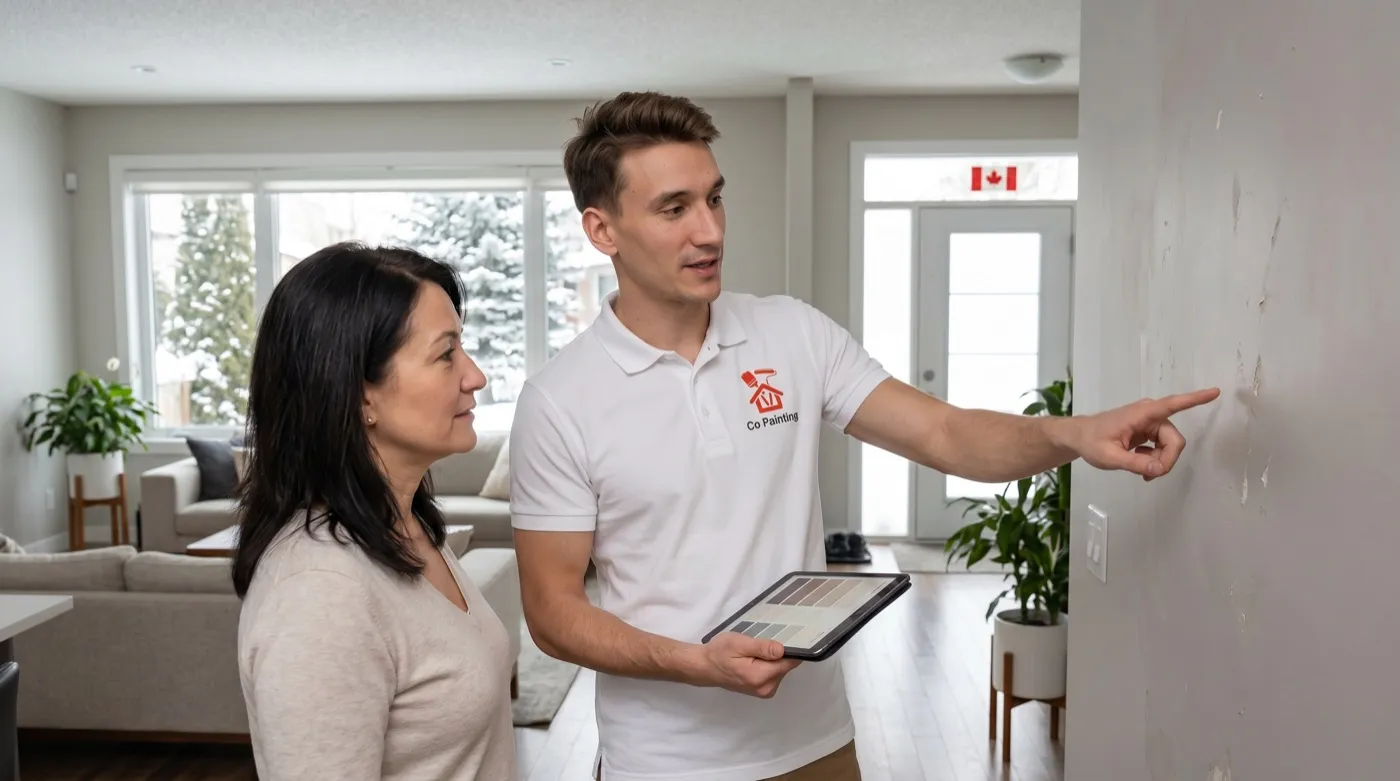
Office Painting Services in North York
Suite repaints after hours
Walls, ceilings, doors and frames inside your leased space, done between the time your last person leaves and the time your first one arrives. We wrap and shift what has to move and put the room back before the shift ends.
Lease turnover and tenant fit-out
Turning a suite between tenants, or painting a fit-out before the furniture lands. Old anchors get filled, bent bead gets replaced, and the walls go back to a neutral. New board gets a drywall primer first, because bare paper and dried compound drink paint at different rates.
Reception, boardroom and brand walls
The two rooms your clients actually see. We match a brand colour from your spec sheet or a printed sample, and we say up front when a deep colour needs a tinted primer and an extra coat.
Drywall and plaster repair before paint
Anchor holes, cracked corners, dented bead, and the stain from last winter's roof leak. We cut the damage out, tape the cracks that keep moving, then sand and prime so the repair does not flash back through the topcoat.
Corridors, stairwells and elevator lobbies
Common areas in multi-tenant buildings, painted overnight in legs so the route out never closes. They take more contact than anything else on the property, so they get a harder washable finish at hand height.
Low-odour paint for occupied floors
Products picked so people can sit at those desks the next morning. Low-VOC office lines are low in odour and dry fast, which counts for more in a sealed tower than in a house with windows.
Hollow metal doors, frames and trim
Office doors and frames are usually pressed steel, and steel takes a different product. Rust gets sanded back, the frame gets a direct-to-metal primer where the factory finish failed, and the topcoat is an enamel that survives door stops and carts.
If your building sits east toward the 404, the same after-hours crew handles offices in Don Mills, and we run the same evening schedule for businesses across East York.
How an Office Repaint Gets Scheduled
The building decides more of the schedule than the paint does. Most North York towers want after-hours work booked through the property manager, with the service elevator reserved, the pads hung, and every worker on the security list before the first night.
Two pieces of paper come up on every commercial job here. A certificate of insurance naming the landlord and the property manager, and a WSIB clearance certificate showing we are registered and paid up. A clearance is good for up to ninety days, so a program that runs across a quarter needs a second one.
Then the work gets cut into pieces that fit your week. A single suite is usually one weekend. A full floor gets split by zone so half the staff keeps working while the other half is boxed up. Every shift ends with the desks back, the cords back and the floor vacuumed.
What moves the price is not floor area on its own. A same-colour refresh over sound walls is the cheap end of it. The number climbs when the colour changes hard, when walls need skimming to take a sheen, when there is wall covering to strip, or when the work has to happen in short windows after seven at night. We measure the space and put the price in writing first.
Why choose us
Why North York Offices Choose Us
We paint when the floor is empty
Evenings, weekends, and zone by zone when the suite has to stay open. The measure of a good office job is that Monday looks normal, with the desks back and the cords plugged in.
Low-odour paint for occupied floors
Low VOC is a federal limit here, not a slogan. Canada's VOC limits for architectural coatings cap an interior flat paint at 100 grams per litre and a non-flat at 150, and we buy at the low end of that for occupied space.
The paperwork your property manager wants
A certificate of insurance naming the landlord, and a current WSIB clearance certificate, sent before the crew shows up. We are fully insured and licensed in Ontario, and our people sign in at security like every other trade.
Fifteen years on the tools, backed for three
Our crews average fifteen years of painting and we are rated 5.0 across 70 Google reviews. The workmanship carries a three-year warranty. If something we painted fails inside that window, we come back and fix it.
Nine Things Worth Knowing Before You Paint an Office
- Price the downtime, not just the paint. A weekend crew costs more per hour and still beats sending a floor of people home on Tuesday.
- Match the sheen to the wall you actually have. Gloss, semi-gloss and enamel are not recommended over a standard Level 4 taped finish, so sheen beside the windows means budgeting a skim coat.
- Never let anyone paint a sprinkler head. Paint that affects performance means the head gets replaced, and the standard does not permit scrubbing or solvent to take it off.
- Keep fire door labels readable. A label painted over or covered stops counting at the annual fire door inspection.
- Wash and prime the black bands first. Thermal tracking is soot, and it bleeds back through fresh paint unless it is sealed with a stain blocker.
- Take the old signage off properly. Vinyl decals and their adhesive ghost through paint, so the residue needs solvent and a primer, not a hopeful second coat.
- Use a washable finish at hand height. Corridors and kitchens fail first in flat paint, and scuff-resistant commercial lines exist for this, Benjamin Moore's Scuff-X among them.
- Keep the field colour neutral and spend the brand colour on reception. Deep colours need a tinted primer and more coats, and they show every repair behind them.
- Get the insurance certificate and WSIB clearance before the first night. A clearance is only valid for up to ninety days, so a long job needs a fresh one.
FAQ
Office Painting Questions, Answered
Can you paint while we work?
For an open office we would rather work after hours. Cutting in around occupied desks is slow, and even low-odour paint is nicer at 9pm than at 9am. Corridors and lobbies are always overnight.
How long does an office repaint take?
A few thousand square feet often runs a weekend or two, depending on the patching and whether the colour is changing. A hard colour change adds a coat. The timeline comes with the written quote.
Will the office smell on Monday morning?
Not the way it used to. Low VOC is a federal limit here, 100 grams per litre for interior flat paint and 150 for non-flat. We still ask the building to run the air handlers overnight.
Do you patch holes and drywall damage before painting?
Yes, and in an office that is most of the work. Anchor holes, dented bead, cracks and water stains get repaired, sanded and primed first. An unprimed patch dries to a different sheen and shows under the lights.
Why do the drywall joints show under our window wall after a repaint?
That is joint photographing. Light crossing a wall at a shallow angle exaggerates anything that is not flat, and gloss and semi-gloss make it worse. Office drywall is usually taped to a Level 4 finish, which is only rated for flat paint. Skimming it first is the fix.
Do you paint sprinkler heads or fire door labels?
No, and no crew should. A sprinkler head with paint that affects performance gets replaced, and the standard does not allow cleaning it off. A painted label on a fire-rated door voids the listing at inspection.
Can you match our brand colours?
Yes. We work from your spec sheet or match a printed sample, and we put the mix on the wall before committing the whole reception to it. Deep colours want a tinted primer and an extra coat.
What insurance paperwork does our property manager get?
A certificate of insurance naming the landlord and the property manager, plus a WSIB clearance certificate. A clearance is valid for up to ninety days, so on a longer program we pull a fresh one.
How do we get a price?
Call or send the form and we book a walkthrough, ideally when the light on the walls is at its worst. The price comes in writing before a night gets booked.