
Need a Dry Wall Contractor in North York?
A dry wall contractor in North York gets called for four things. A wall that is damaged, a wall that does not exist yet, a ceiling that got wet, and old plaster that will not stay flat. We do all four, and we paint the finish after, which decides whether the repair disappears.
North York was farmland until the war and filled in fast afterwards, through the late 1940s, the 1950s and the 1960s. Bungalows and side-splits on deep lots first, then the towers along Yonge, Sheppard and Finch. Drywall pushed lath and plaster out of Canadian homes somewhere between the 1930s and the 1950s, right through the years this part of the city was going up, so the age of your building tells us most of what we need.
In the older houses it is plaster. A hairline over a door frame, a ceiling that sounds hollow when you knock, a horizontal line that reopens every heating season. In the postwar houses it is board, and board fails at its fasteners and seams. In a condo it is anchor holes from a TV mount or a stain spreading down from the suite above. If you are not sure which you have, sorting that out is the first thing we do on site.
What Drywall and Plaster Work Takes
The colour is not the hard part. Most of a repair happens before anything is painted, and the order decides whether it holds.
We start by knocking on the wall. Sound plaster answers back hard and tight. A hollow, drummy note means the keys behind it have broken, and that section gets re-anchored before anything is skimmed over it. Board answers differently and takes a different fix. That test costs two minutes and sets the quote.
Then we work out whether a crack has settled or is still moving, because filler over a live joint is a repair with a season on it. The clearest case is the crack along the top of an interior wall that opens through winter and closes by summer. On a truss-framed roof that is truss uplift. The bottom chord sits buried in attic insulation while the upper chords sit in cold attic air, the two gain and lose moisture at different rates, and the truss arches up off the wall below. It is not structural. The fix is to stop fighting it, so the ceiling gets freed from that partition and the corner floats, or the junction gets trimmed so the movement hides. Older stick-framed houses crack from seasonal wood movement instead.
Water comes first. We do not patch a ceiling still fed by a live leak, and we say so on the spot. The source gets fixed first, the board dries, then we cut, seal and re-tape.
Compound choice is a decision, not a habit. Ready-mix dries by evaporation, so in a cold or damp room one coat can want most of a day. Setting compound hardens chemically instead, comes in five, twenty, forty-five and ninety minute set times, and shrinks less in a deep fill. The last pass gets something that sands easily.
Then the dust, and what is in it. Canada did not limit lead in paint until 1976, so in any pre-1980 home we treat the lower layers as lead until proven otherwise, seal the room off and prep wet. Ceiling texture sprayed before 1985 is the most likely to carry asbestos, and existing stock kept getting used into the early 1990s. Anyone who disturbs it falls under Ontario Regulation 278/05, so a lab sample comes first.
Once the wall is flat the finish coat matters as much as the patch, which is why we quote the paint with it and hold it to the same specs as our interior painting work. We work across the north end of the city, from the 1950s houses through Don Mills to the postwar bungalows in East York.
Dry Wall Contractor Services in North York
Drywall repair
Holes, dents, popped screws, cracked seams, and outside corners crushed by furniture. Anything past about fist size gets backing behind it, because compound with nothing under it cracks the first time that wall takes a knock. Popped fasteners have a documented cause. Framing lumber can arrive carrying up to nineteen percent moisture and dries to nearer ten percent once the house is heated, so the stud shrinks off the board while the screw stays put. Driving that screw back in does nothing. A new one goes in about an inch and a half away.
Drywall installation
New board hung, taped and finished for basement builds, additions, second suites, and partitions inside a finished unit. We straightedge the framing before a sheet goes up, because a crowned stud telegraphs through the wall no matter how good the taping is, and it is ten minutes to fix while the wall is open.
Plaster repair and skim coating
Real plaster work on the pre-1960 walls and ceilings, not a smear of filler over a crack that reopens in January. Hollow sections get drawn back to the lath with screws and plaster washers, then the whole plane gets skimmed flat, because a patch that stops short reads as a low spot under side light.
Ceiling repair and water damage
Stains, cracks along a joist line, sagging board, and the ragged hole a light fixture left behind. A water stain is water-soluble and so is paint, so the ring returns through a fresh coat unless it is sealed with a stain-blocking primer. Then we patch, match the texture or skim it flat, and roll the ceiling corner to corner.
Tape and mud finishing
Seams, inside corners and outside corners brought to a paint-ready finish. Paper tape carries the higher tensile strength and comes pre-creased, so inside corners get paper. Level 4 is the standard, tape embedded plus three coats, then a drywall primer before the colour.
Fire-rated and moisture-resistant board
Not every wall takes the same panel. Type X fire-rated board goes wherever an assembly has to carry a fire-resistance rating, such as a party wall or the separation between a house and an attached garage, and it is thicker than the half-inch used on ordinary walls. Bathrooms get moisture-resistant board, and a fibreglass-faced panel beats the green paper-faced kind because there is no paper for mould to live on. Ceilings get a sag-resistant panel, made lighter on purpose so it does not droop between the joists.
Prime and paint after repair
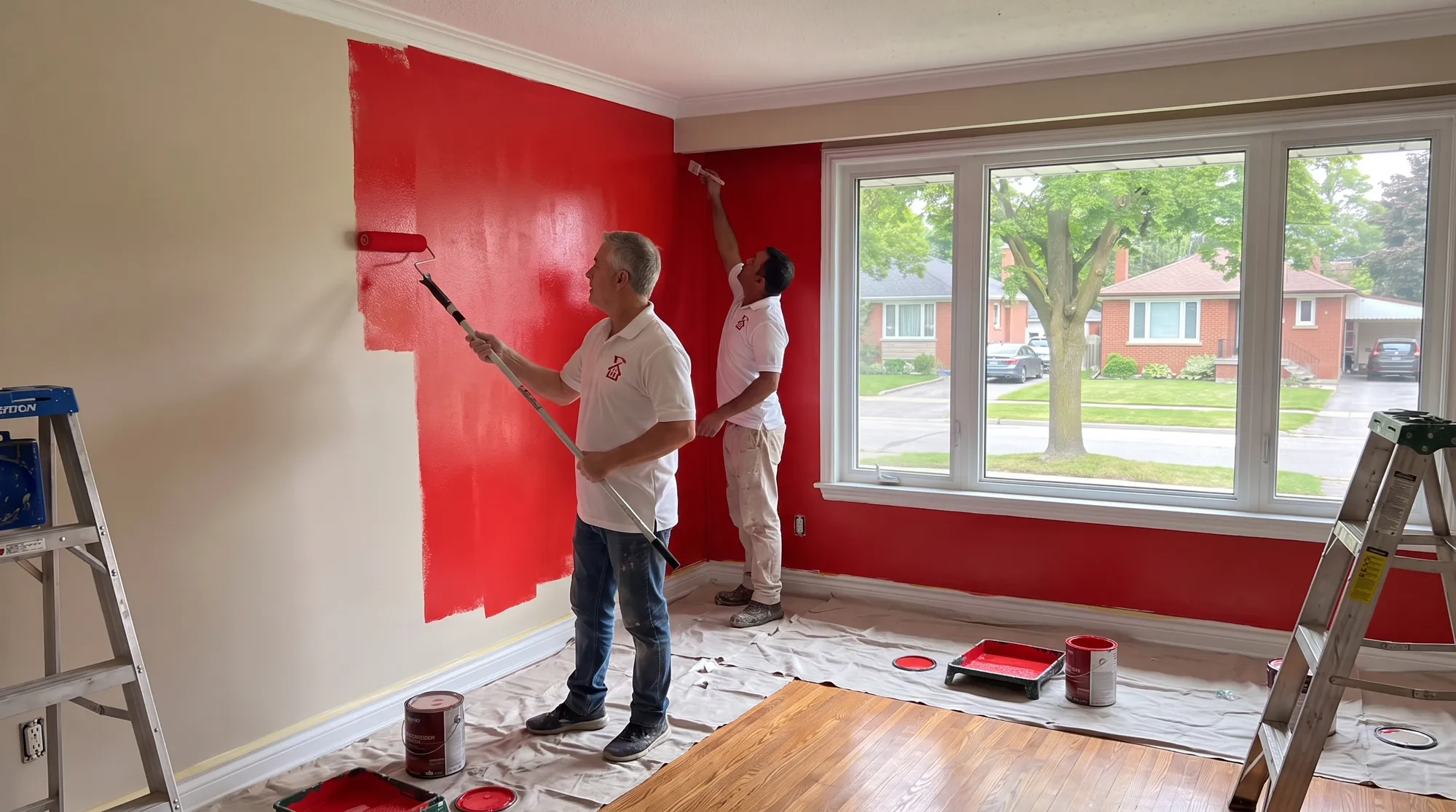
Every repair gets primed, because bare compound pulls paint in at a different rate than the wall around it and dries to a different sheen. Then the wall gets painted right across, not just over the patch.
Why choose us
Why North York Homeowners Choose Us
We prep pre-1960 homes the safe way
Canada did not limit lead in paint until 1976, so we treat the lower layers in any pre-1980 home as lead-bearing, not a surprise found halfway through. We seal the room, prep wet and clean as we go. Pre-1985 textured ceilings get a lab sample before anybody touches them.
The dust stays where the work is
Sanding compound makes a fine dust that finds every room in a house that has not been closed off. We plastic off the work area, sand with vacuums where the job allows, cover the floors, and clean up every day. We are 100% insured and licensed in Ontario.
One crew from the board to the last coat
Most drywall jobs get split between a taper and a painter, and the flaws land in the gap between them. We do the patch, the prime and the finish coat ourselves. One quote, one warranty, nobody to point at later.
Low-odour paint you can live with
Once the wall is flat we finish it in low-VOC, low-odour paint, so you are not pushed out of the room by the smell. Safe around kids and pets, and it holds up because we do not buy cheap paint.
Fifteen years on the tools, backed for three
Our crews average fifteen years on the tools and we are rated 5.0 across 70 Google reviews. The three-year workmanship warranty covers the repair and the paint over it, not one or the other.
Nine Things Worth Knowing Before Drywall Repair
- Fix the leak before you touch the ceiling. Paint does not stop water, and the stain returns through a fresh coat if the source is still running.
- A crack that moves needs tape, not filler. If it opens every winter and closes by summer, filler buys you one season.
- Prime every patch. Fresh compound drinks paint at a different rate than the wall around it, so an unprimed repair shows later as a dull halo once the light hits it right.
- Skim coating is a process, not a coat. Several thin passes with drying time between them beat one thick smear, which shrinks and cracks.
- Plaster is not drywall. On a pre-1960 wall the surface hangs on keys behind the lath, so the repair starts with re-anchoring, not with a tub of mud.
- Ask what level of finish you are buying. Level 4 is standard for flat paint. If the room has a long window down one wall, or you want gloss or a dark colour, raise Level 5 before taping starts.
- Texture match is a skill of its own. Stipple and knockdown are matched by tool, pressure and mix, and a mismatched patch ends up louder than the damage.
- Do not rush the dry time. Compound recoated while still wet shrinks later, and the crack shows up in your paint rather than the mud.
- Get the patch and the paint in one quote. One crew means one warranty and no argument about whose work the flaw belongs to.
FAQ
Dry Wall Contractor Questions, Answered
How do I know if I have plaster or drywall behind my paint?
Knock on it. Plaster answers back hard and dense. Drywall sounds hollower between the studs. Age is the other clue. Drywall pushed lath and plaster out of Canadian homes between the 1930s and the 1950s, so the older North York houses are usually plaster and the postwar ones are usually board.
Why does the same crack come back every winter?
Because something behind it is still moving, and filler cannot hold a joint that moves. A crack that opens in the heating season and closes by summer is usually seasonal wood movement, or truss uplift. Neither is structural. Both need the joint taped or the corner freed rather than filled again.
Do you prime and paint after the repair?
Yes, and we recommend it. Patch, prime and paint is our standard package. A repair left unprimed, or painted only in the patched area, shows up a month later as a different sheen.
How long after patching before it can be painted?
It depends on the depth of the fill, the compound and the humidity. Ready-mix can want most of a day per coat in a cold or damp room. Setting compound hardens chemically, in set times as short as five or twenty minutes. We sand and paint when the mud is actually dry.
Can you fix a ceiling with a brown water stain?
Yes, once the leak is fixed and the board is dry. The ring is water-soluble, so it bleeds straight back through ordinary paint. We seal it with a stain-blocking primer, repair what the water damaged, then roll the full ceiling.
What is a Level 5 finish, and do I need one?
Level 4 is the standard residential finish. Tape embedded, three coats over joints and fasteners, primer, then flat or matte paint. Level 5 adds a thin skim coat over the whole surface, for severe light or for gloss, semi-gloss and dark colours. Most rooms do not need it.
My ceiling is textured. Can you scrape it off?
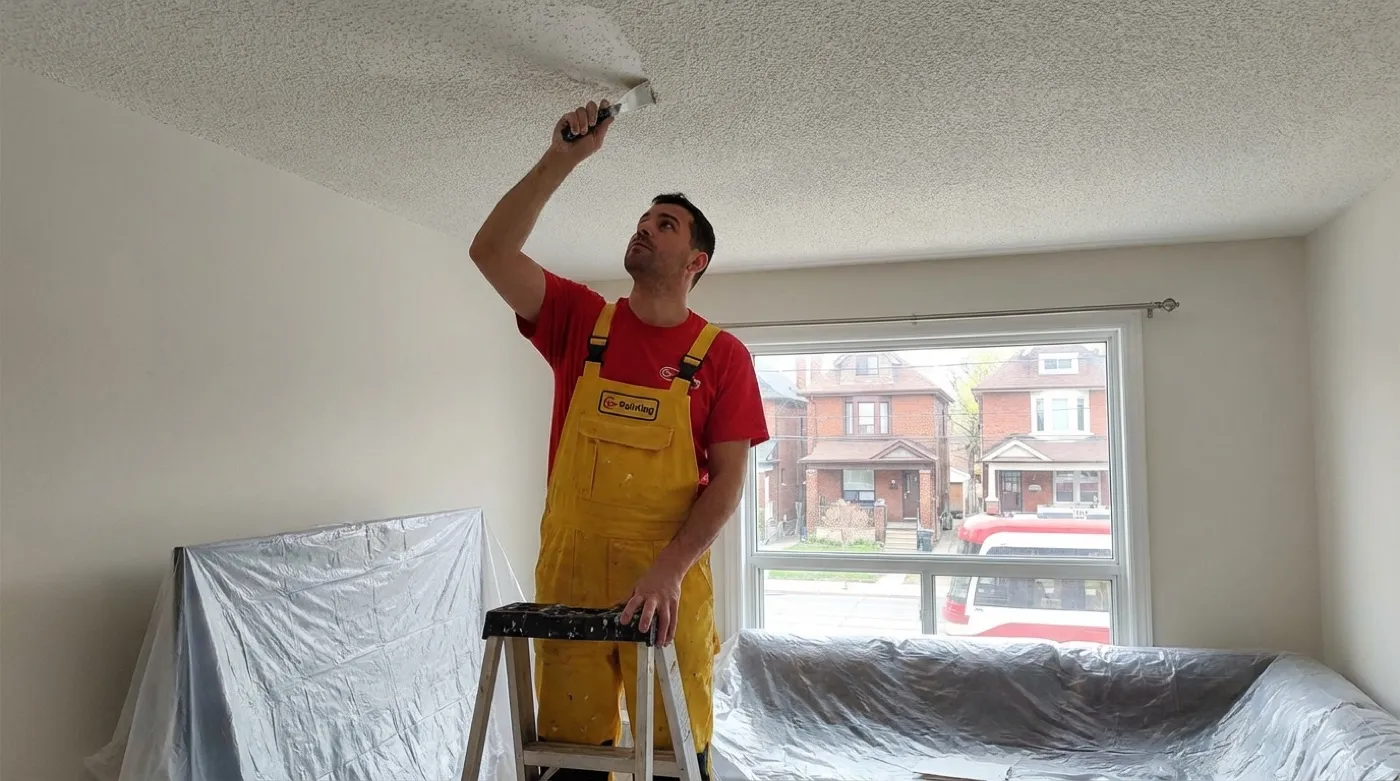
Not before it is tested. Ceiling texture sprayed in Toronto before 1985 is the most likely to carry asbestos, and existing stock kept getting used into the early 1990s. Anyone who disturbs it falls under Ontario Regulation 278/05, so a small sample goes to an accredited lab first.
Do you work in condos and apartment buildings?
Yes. We book the elevator, work inside the building's hours, and protect the corridor as well as the unit. In a tower the ceiling damage usually comes from the suite above, so we will say plainly when the building has to deal with the source first.
Are you insured, and how do I get a price?
We are fully insured and licensed in Ontario, and the workmanship carries a three-year warranty. For a price, call or send the form and we book a free estimate. We look at the real damage, because a crack filled twice already is a different job, and the number comes to you in writing first.